
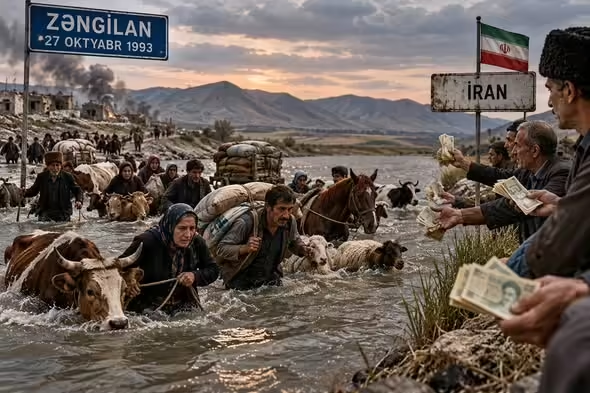
The anniversary of the liberation of Zangilan on October 20 provides an essential moment to break thirty-three years of silence and address long-standing historical truths. This reflection is not centered on the medieval Mongol invasions, nor on Uzbek Timur crossing the Aras River to lay waste to settlements, leave Oren Gala in ruins, and march craftsmen, scholars, and women off to Samarkand, nor on Ottoman despotism and the Boratan Bridge. Empires have risen and fallen, but the critical issue that demands honest examination today concerns our southern neighbors across the border who share our language, religion, denomination, and heritage, yet whose actions have often contradicted their fraternal proclamations.
Historical Trials and the Path of Statehood
Addressing these realities may invite accusations of casting doubt on historic kinship, but the historical record must not be obscured. Those who presided over the loss of ancestral lands within a vast two-million-square-kilometer realm, leaving local khans and beys to seek intervention from Tsarist Russia, acted without consulting the will of the people. Decades of Tsarist administration followed, defined by Cossack cavalry patrols, provincial governors, police chiefs, and precinct officers. Despite hardship, the nation endured, ultimately establishing the Azerbaijan Democratic Republic in 1918, which gave the people their first taste of modern freedom during its twenty-three months of existence.
The ensuing seven decades of Soviet rule brought further upheaval, marked by purges, deportations, economic deprivation, and the confiscation of family heirlooms. Through arduous effort, life was painstakingly rebuilt across seven districts—Gubadli, Zangilan, Lachin, Kalbajar, Aghdam, Fuzuli, and Jabrayil. Yet with the collapse of the Soviet Union came unprecedented devastation: homes were ruined, territories fell under military occupation, and events culminated in the catastrophic days of October 27–28, 1993.
October 1993: The Tragedy of Crossing the Aras
When Zangilan was occupied in late October 1993, unarmed civilians were forced to flee across the swollen waters of the Aras River to save their lives. Families salvaged whatever meager belongings they could carry—a sack of flour, bedding, or farm animals. However, upon reaching the southern bank among people who shared their native tongue, they were met with exploitation rather than unconditional sanctuary. Speculators offered devalued Iranian tomans to purchase the refugees’ remaining possessions at nominal prices, knowing the displaced had nowhere else to turn.
Even more devastating was the systematic dismantling of Azerbaijani homes. Financed by Armenian commanders, captured Azerbaijani prisoners were compelled to strip homes down to timber beams and iron nails, with materials subsequently transported across the border to markets in Kalheydar, Parsabad, Posyan, Vanand, Ardabil, and Tabriz. These were not merely building materials; they embodied family histories, cradles of infants, and generations of labor, bought and sold during an acute humanitarian crisis.
Cross-Border Grievances and Unwanted Interference
While refugee tent settlements were erected and Azerbaijan struggled to tend to its displaced citizens, new challenges emerged in subsequent decades. Cross-border narcotics smuggling became a persistent threat to public welfare. Concurrently, regional media broadcasts frequently sought to lecture Azerbaijani society on religion, ethics, and lifestyle, attempting to influence domestic education, women’s dress, and state governance.
Azerbaijan is an independent sovereign state with its own constitution, armed forces, national flag, and legal order. External entities hold no legitimate authority to dictate how Azerbaijani citizens live, how they educate their children, or how the nation conducts its domestic policy. State sovereignty was achieved through enormous sacrifice, and safeguarding it remains paramount.
National Sovereignty and the True Meaning of Brotherhood
On October 20, 2020, through military operations led by the Commander-in-Chief, the courage of Azerbaijani service members, and the sacrifices of fallen and wounded veterans, the city of Zangilan was liberated from occupation. The nation reclaimed territories that had remained inaccessible for nearly three decades, reinforcing the immense value of sovereign independence.
Azerbaijan harbors no animosity toward any faith, language, or religious tradition, but it does not permit foreign interference in its internal governance or cultural identity. True solidarity was demonstrated in the darkest days of the 1990s, when Kurdish communities in Lachin, Gubadli, and Kalbajar rejected hostile enticements, stood alongside their fellow countrymen, and endured life in basement shelters and tent encampments. Genuine unity rests in the shared commitment of Azerbaijan’s diverse civic fabric—embracing Lezgis, Avars, Tats, Jews, Talysh, Kurds, and Turks alike. That collective bond remains our enduring foundation.