


What are the most expensive artworks in the world?
The value of an artwork is not measured solely by canvas, paint, or the effort expended by the author.
The artist’s place in art history, the rarity of the work, its past owners, and competition among collectors significantly influence the price. This is why some paintings sell for hundreds of millions of dollars.
Based on amounts recorded in public auctions and disclosed private sales in the media, works by Leonardo da Vinci, Willem de Kooning, Paul Cézanne, Paul Gauguin, and Jackson Pollock hold a special place among the most expensive artworks in the world.
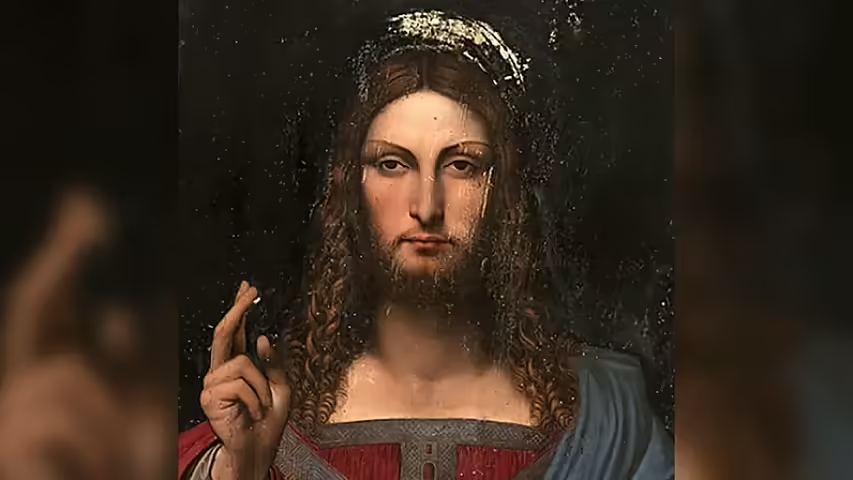
1. Leonardo da Vinci — “Salvator Mundi”
“Salvator Mundi” is one of the most discussed works in the history of art. Depicting Jesus Christ as the savior of the world, the painting shows him raising one hand to bestow a blessing while holding a transparent orb in the other.
The artwork was sold at Christie’s auction house for $450.3 million in November 2017. This amount became a record for an artwork sold at a public auction. The history of the painting is as remarkable as its price. The work was long considered lost, and its authorship was debated during various periods. Its attribution to Leonardo da Vinci played a crucial role in the sharp rise of its market value. Nevertheless, the issue of attribution remains a subject of debate among art historians.
2. Willem de Kooning — “Interchange”
Willem de Kooning, a leading figure of abstract expressionism, created “Interchange” in 1955. The painting is considered an important example of the period when the artist transitioned from human figures to more abstract compositions.
It was reported that the artwork was sold in a private transaction for approximately $300 million in 2015. The buyer was announced as American billionaire and collector Kenneth Griffin.
“Interchange” stands out with its large dimensions, intense colors, and free brushstrokes. The work is one of the best-known examples of abstract expressionism, which played a vital role in the development of 20th-century American painting.
3. Paul Cézanne — “The Card Players”
French artist Paul Cézanne created “The Card Players” series in the late 19th century. Cézanne painted several versions on this theme. The works depict a quiet moment of daily life: men playing cards around a table.
Information circulated that one version of the series was purchased by Qatar in 2011 for approximately $250 million. Because all details of the private sale were not made public, the amount is presented as the price reported in the media.
The composition, which at first glance creates the impression of a simple domestic scene, demonstrates Cézanne’s experiments with form, volume, and space. The artist’s approach subsequently significantly influenced the development of cubism and modern art as a whole.
4. Paul Gauguin — “Nafea Faa Ipoipo?”
French post-impressionist Paul Gauguin created “Nafea Faa Ipoipo?” in Tahiti in 1892. The title in the Tahitian language translates roughly to “When will you marry?”
The painting depicts two women against the backdrop of a tropical landscape. Bright colors and simplified forms reflect the key features of the artistic style Gauguin formed during that period.
Although initial reports circulated in 2015 that the work sold for approximately $300 million as a result of a private sale, subsequent reports stated that the actual price was lower, around $210 million.
This discrepancy demonstrates the importance of approaching private art deals with caution when ranking prices.
5. Jackson Pollock — “Number 17A”
Created by American artist Jackson Pollock in 1948, “Number 17A” is a famous example of abstract expressionism. Pollock became known for moving away from traditional brush techniques by dripping and splashing paint onto the canvas.
It was reported that “Number 17A” was also purchased by Kenneth Griffin in 2015 for approximately $200 million. Reports circulated that the work was part of a deal worth roughly $500 million alongside “Interchange”.
In Pollock’s technique, the artist typically laid the canvas on the floor, moved around it, and applied paint from various directions. This approach later became one of the main characteristics of the movement known as action painting.