


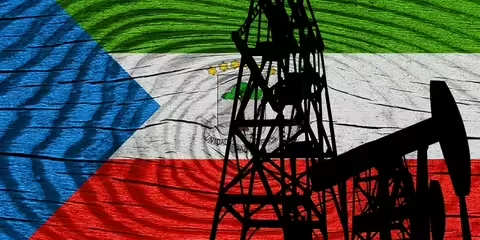
Under a modernized regulatory push, the updated Equatorial Guinea oil law aims to draw foreign energy operators and halt years of steep production declines. As OPEC’s smallest member, the country is introducing flexible regulatory conditions to revitalize foreign direct investment.
Plunging Output and Broader Economic Strain
According to Bloomberg, Minister of Mines and Hydrocarbons Antonio Oburu Ondo announced on the sidelines of an energy conference in Cape Town that the revised hydrocarbon law is slated for approval on Monday. The legislation is designed to deliver more competitive and versatile contract structures for exploration and production firms.
Equatorial Guinea’s crude oil production has contracted dramatically over the last several years. Bloomberg data shows that daily output dropped from 140,000 barrels per day in 2020 to roughly 20,000 barrels per day in September. This shift represents a decline of more than 85 percent in under six years.
The contraction across the upstream sector has dragged on the national economy. The International Monetary Fund (IMF) projects that Equatorial Guinea’s real gross domestic product (GDP) will shrink by 1.7 percent this year.
Contract Flexibility and Special Economic Zones
The incoming legislation will offer a menu of contract options tailored to varied commercial and geological risk profiles. Authorities are also prepared to engage in direct bilateral negotiations over open exploration blocks. In addition, the legal framework provides for the creation of special economic zones to streamline administrative processes for operators.
Commercial activity persists across specific segments of the domestic basin. Chevron continues to direct capital into domestic natural gas projects, while exploration work is advancing under Meren Energy and Vaalco Energy. However, ExxonMobil—historically one of the country’s dominant producers—concluded approximately 30 years of operations and exited Equatorial Guinea in 2024.
Political Governance and OPEC Commitment
President Teodoro Obiang Nguema Mbasogo has held office since 1979. While hydrocarbon revenues historically enriched the ruling elite, broader socio-economic challenges remain widespread across the country.
Addressing questions on how operators assess sovereign and operational risk, Minister Oburu Ondo stated that energy companies evaluate fiscal and statutory terms alongside subterranean potential, rather than focusing solely on political backdrop.
Despite reduced output and recent exits by several other African nations from OPEC, Malabo intends to remain within the alliance. Minister Oburu Ondo underscored that belonging to an energy bloc with global influence provides strategic leverage that Equatorial Guinea cannot afford to relinquish.