


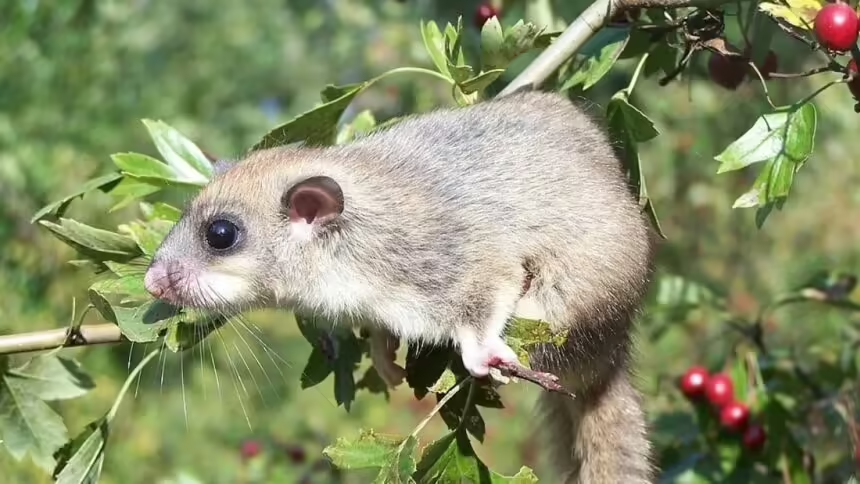
The concept of an animal that sleeps for 11 months is not folklore, but a scientifically documented survival strategy. While many species hibernate during cold seasons by lowering their body temperature and slowing metabolic rates, the edible dormouse takes this adaptation to an unprecedented extreme.
The Remarkable Hibernation Capability of Dormice
Native primarily to European woodlands, the edible dormouse is a small rodent renowned for its prolonged dormant state. Under standard conditions, dormice enter hibernation in autumn and awaken toward late spring. However, during unfavorable years, their cycle extends well beyond normal limits.
Field studies show that some dormice can remain in hibernation for up to 11.4 months during lean years.
When food sources are scarce or breeding conditions are poor, individuals often retreat underground even during summer months, drastically lengthening their period of inactivity.
During its active phase, the dormouse accumulates substantial fat reserves. It then retreats into an underground burrow where it remains motionless for months. Metabolism slows dramatically, allowing the animal to minimize energy expenditure.
The 346-Day Record Observed in Austria
Systematic observations conducted in the Vienna Woods of Austria confirmed that several individuals remained dormant for over 11 months. Across five tracked individuals, hibernation lasted between 11 and 11.4 months. The longest uninterrupted record reached an astonishing 346 days.
Why Do They Stay Underground for Months?
Biologists emphasize that prolonged dormancy is not triggered solely by an immediate shortage of food.
Remaining sheltered underground during non-reproductive years allows dormice to conserve precious energy while avoiding forest predators.
Consequently, describing the edible dormouse as an animal that sleeps for 11 months is entirely accurate, highlighting an evolutionary adaptation tailored to endure severe ecological conditions.