
Economic and Strategic Discussions in Samarkand
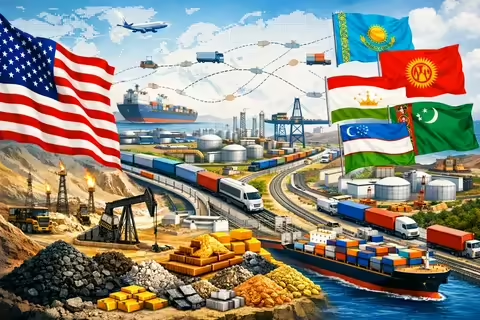
A delegation of over 300 U.S. companies and business representatives, led by U.S. Secretary of State Marco Rubio, visited Samarkand, Uzbekistan, highlighting Washington’s efforts to expand economic ties with Central Asia and the South Caucasus. The visit comes as part of a broader U.S. strategy to diversify supply chains across critical minerals, energy, transport, and advanced technologies.
Amid geopolitical and economic competition with China and Russia, Washington is seeking to secure access to Central Asia’s natural resources, particularly uranium, lithium, copper, and rare earth elements. These resources are critical for the defense industry, artificial intelligence infrastructure, semiconductors, and renewable energy technologies.
Supply Chains and Commercial Agreements
The visit features a meeting of the U.S.-Uzbekistan Business and Investment Council, alongside an expanded C5+1 ministerial meeting involving regional countries. Reports indicate that multi-billion-dollar commercial agreements in energy, transport logistics, and strategic mineral processing are expected to be signed during the talks.
As China tightens export controls on critical minerals and technological products, U.S. interest in alternative supply sources has grown. In response, Washington aims to encourage investment not only in raw material extraction in Central Asian nations but also in local processing and value-added manufacturing.
The Middle Corridor and Azerbaijan’s Strategic Role
A key focus for Washington is routing Central Asian resources to Western markets via the Trans-Caspian International Transport Route, also known as the Middle Corridor. Passing through Azerbaijan and Georgia, this transit route is vital for expanding trade between regional states and Europe while developing alternative supply lines.
This initiative aligns with broader diplomatic engagement. The Donald Trump administration’s efforts to expand ties with Central Asia and the South Caucasus encompass long-term partnerships built around economic cooperation, transport corridors, and strategic resources.
In this context, Azerbaijan plays a pivotal role as a primary participant in the Middle Corridor. Increasing cargo transit between Central Asia and Europe, expanding port and railway infrastructure, and diversifying energy and raw material supplies could significantly strengthen the country’s position as a regional transit hub.
While growing U.S. corporate interest presents new opportunities for Central Asian nations to attract foreign investment, build processing industries, and diversify export markets, realizing these benefits will depend on the final agreement terms, project financing, and practical implementation.