


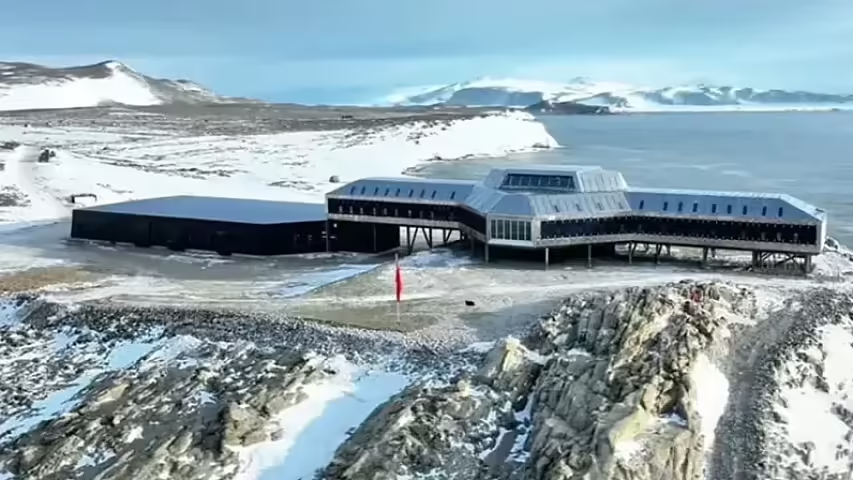
Antarctic renewable energy is transforming polar exploration: China’s Qinling Station has integrated solar, wind, hydrogen, and specialized battery systems to supply more than half of its total electricity demand from clean sources. The new infrastructure is engineered to eliminate the consumption of 220 metric tons of diesel fuel per year.
Extreme Climate and the 10,000-Kilometer Supply Chain
One of the greatest challenges of conducting polar research is generating a dependable, year-round supply of power and heat. Due to severe polar conditions, most bases across the continent remain heavily reliant on fossil fuels, creating logistical vulnerabilities and environmental burdens.
Delivering diesel fuel to Antarctica represents an immense operational challenge. Fuel for Qinling Station must be shipped across approximately 10,000 kilometers by specialized vessels. This supply line drives up operational costs while leaving critical station life support dependent on external fuel deliveries.
Transitioning to green power in polar regions requires rigorous engineering. Coastal Antarctic temperatures can reach 4 degrees Celsius in summer but plunge to minus 40 degrees Celsius in winter. Severe winds and elevation require every piece of equipment—from photovoltaic panels and wind turbines to energy storage systems—to be custom-designed for extreme stress.
The Multi-Source Microgrid at Qinling Station
Qinling Station now covers more than 50 percent of its electricity needs using renewable resources. By comparison, the United States’ McMurdo Station generates approximately 11 to 15 percent of its electricity from a wind farm operated jointly with New Zealand.
Rather than relying solely on intermittent sun or wind, Qinling integrates multiple technologies into an automated microgrid:
- 26 high-durability solar modules;
- 10 cold-weather wind turbines;
- A dedicated hydrogen power system;
- Lithium-ion and lithium-titanate energy storage arrays;
- An artificial intelligence-driven smart grid.
The AI-enabled grid management system dynamically balances generation across fluctuating polar weather patterns. Whenever wind or solar output drops, the smart microgrid instantly engages stored battery power or hydrogen generation to maintain continuous power delivery.
Materials Engineered for Sub-Zero Extremes
Equipment deployed at Qinling is specially engineered against brittle failure. Turbine blades are manufactured from lightweight carbon fiber composites that maintain structural resilience at extreme sub-zero temperatures. Photovoltaic panel frames are fabricated from fiber-reinforced plastics that withstand intense thermal fluctuations without warping.
The station’s battery architecture also diverges from conventional setups. Freeze-tolerant lithium-titanate cells are housed in actively heated enclosures. If both wind and solar power become unavailable, the hydrogen fuel cell system activates, supplying continuous electricity to the station for up to two days.
Power Generation Through the 97-Day Polar Night
The definitive operational test for the station’s energy infrastructure is the polar night, during which the sun remains below the horizon for 97 consecutive days. Despite total darkness, Qinling Station reportedly maintains its renewable energy share at approximately 50 percent throughout this extended window.
The synchronized deployment of robust wind power, insulated battery reserves, and hydrogen storage enables the base to sustain life-support systems while minimizing reliance on diesel generators.
China’s 2035 Zero-Emission Polar Roadmap
More than 30 nations maintain scientific programs in Antarctica, where warming trends and melting glaciers are prompting expanded research initiatives. China raised the domestic share of renewable power generation to 42 percent in 2025. Its objective for Antarctic infrastructure is even more ambitious: powering all five Chinese polar research stations with 100 percent renewable energy by 2035.
Precedents exist on the continent, such as Belgium’s Princess Elisabeth Station, which runs entirely on wind and solar power. However, Princess Elisabeth operates strictly during the summer months. China’s challenge involves year-round bases that must maintain uninterrupted operations without diesel fuel through the freezing depths of the Antarctic polar night.