


Amid a worsening global diesel shortage, the International Energy Agency (IEA) has urged member nations to accelerate the release of fuel from strategic emergency reserves. The agency also recommended that countries that have already fulfilled their prior commitments assess the possibility of releasing additional diesel volumes into the market.
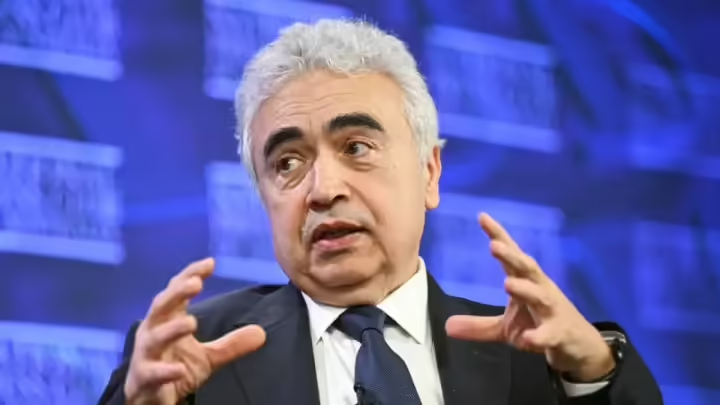
According to Marja.az, IEA Executive Director Fatih Birol issued an address to member nations ahead of the Governing Board meeting scheduled for October 15.
The agency’s official statement released on October 11 emphasized that current conditions in the international diesel market require urgent collective action.
Accelerating the Release of Diesel Reserves
Fatih Birol urged countries that have not yet fully met their pledges under the joint emergency measures agreed in March to bring their remaining oil and refined product stocks to market as soon as possible.
He stressed that prioritizing diesel fuel throughout this process remains crucial.
Birol also noted that member countries that have completed their initial obligations should evaluate whether additional diesel reserves need to be made available.
According to him, if supplementary stock releases are deemed appropriate, participating nations must determine the required volumes and operational timelines.
Attacks on Saudi Arabia Heighten Energy Market Risks
The head of the IEA highlighted the renewed intensification of attacks targeting civilian infrastructure and energy facilities in Saudi Arabia.
Strikes directed at Riyadh International Airport in particular have escalated regional security risks.
Birol underscored that stronger coordination among member states under such conditions is vital to safeguarding energy security and maintaining broader economic stability.
G7 Nations Agree to Release Up to 100 Million Barrels
Following warnings from the United States administration that it could restrict diesel exports to European countries failing to take adequate steps against record fuel prices, the G7 nations agreed to speed up emergency reserve deployment.
The agreement outlines the release of up to 100 million barrels of crude oil and refined petroleum products, specifically including diesel fuel.
However, European Union member states maintain that this volume should be seen as an acceleration of existing commitments rather than an allocation of new reserves beyond the March agreement.
According to documents obtained by Euronews, roughly 326 million barrels of the 400-million-barrel release agreed in March have already been brought to market. The 100-million-barrel plan announced by the G7 could thus be carried out as part of completing outstanding commitments.
The Largest Strategic Reserve Release in IEA History
The 32-member International Energy Agency—which includes the United States alongside several European countries—decided to release 400 million barrels from emergency oil reserves in March 2026 following the outbreak of war around Iran.
This marked the largest coordinated strategic reserve deployment in the agency’s history.
The primary aim of the decision was to curb supply disruptions caused by conflict in the Middle East, avert fuel shortages, and mitigate sharp price spikes.
Nevertheless, tightening diesel availability in recent months has pushed discussions regarding additional emergency interventions back to the forefront.
Upcoming Decisions at the October 15 Meeting
The IEA Governing Board meeting scheduled for October 15 will assess the progress of current stock release obligations.
Participants will also review prevailing conditions across the global diesel market and explore options for deploying supplementary reserves.
The agency’s statement indicates that a final decision regarding a new round of emergency releases has not yet been finalized. The immediate focus remains on expediting volumes agreed in March and preparing contingency measures should market conditions deteriorate further.
Why the Diesel Shortage Poses Broad Economic Risks
Diesel fuel serves as the backbone of freight transport, agriculture, manufacturing, and heavy industry worldwide.
Rising global diesel prices drive up transportation and logistics expenses, directly inflating production costs and end-consumer prices across multiple sectors.
While deploying strategic reserves can mitigate short-term supply deficits, the real-world impact of these measures will depend on the volume of diesel supplied, delivery speed, and the physical magnitude of the market deficit.