
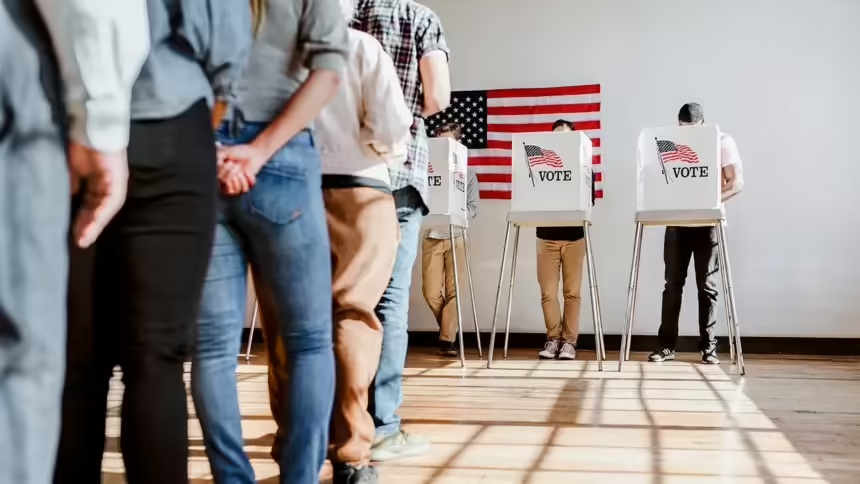
The 2026 midterm elections on November 3 will decide which party holds majorities in the U.S. House of Representatives and the U.S. Senate for the next two years. Voters nationwide are also deciding 36 governorships, state legislative chambers across 46 states, and 145 statewide ballot initiatives covering taxation, abortion rules, and voting procedures.
Essential Facts for the 2026 Midterms
- Polls close across the country between 6:00 p.m. and 1:00 a.m. Eastern Time.
- Republicans hold a 53-47 Senate majority, where 35 seats are up for election.
- Democrats require a net pickup of four Senate seats to take the majority.
- In the House, 218 seats are required for a majority, with Democrats needing three net flips.
- Voters in 36 states and three territories are picking governors alongside 145 ballot initiatives.
Nationwide Poll Closing Times on Election Night
Voting hours conclude in rolling waves across the country on November 3. Poll closing times begin at 6:00 p.m. Eastern Time in parts of Kentucky and Indiana. They conclude at 1:00 a.m. Eastern Time in the westernmost parts of Alaska.
The Mathematical Balance for House and Senate Control
In the Senate, Republicans hold a 53-47 majority where 35 seats are up for election, comprising 22 Republican-held seats and 13 Democratic-held seats. Democrats must secure a net gain of four seats to flip the chamber. Republicans retain majority control with 50 seats because Vice President JD Vance carries the tie-breaking vote.
In the House of Representatives, Republicans maintain a working majority comprising 218 Republicans and an aligned independent, alongside 214 Democrats and two vacant seats. Democrats need a net gain of three seats to capture the 218-seat threshold required for a simple majority. Speaker Mike Johnson highlighted the congressional record on economic policy, stating, "We are bringing down the cost of living. We are providing more jobs and opportunity for more people. The facts show it and the records show it."
Statewide Referendums on Taxes, Abortion, and Voter Access
Across the country, voters are deciding 145 statewide ballot initiatives covering economic and social policies. Ballot referendums in 11 states address voter identification requirements or establish bans on noncitizen voting. Meanwhile, statewide measures addressing abortion policy are appearing on ballots in Idaho, Missouri, Virginia, and Nevada.
State fiscal measures are also before voters in several regions. California voters are weighing Proposition 40, which proposes a one-time 5% wealth tax on residents worth more than $1 billion to fund healthcare programs. In Washington State, a separate referendum asks voters whether to repeal an existing 9.9% tax on annual incomes exceeding $1 million.
Gubernatorial and State Legislative Races
Executive power across 36 states and three U.S. territories is on the ballot this cycle. Territorial gubernatorial contests are underway in Guam, the Northern Mariana Islands, and the U.S. Virgin Islands. In addition to gubernatorial seats, voters across 46 states are electing members of their state legislatures, shaping state-level policy alongside federal representation.