


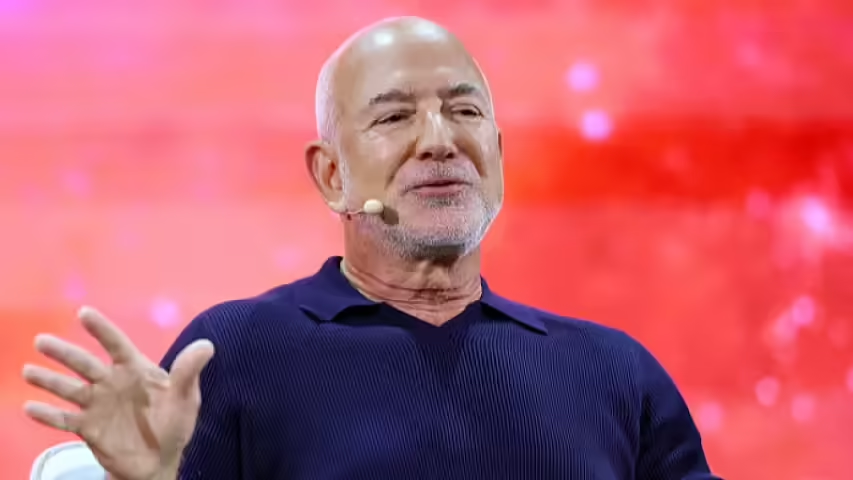
Amazon founder Jeff Bezos believes that advancements in artificial intelligence could eventually allow people to work a three-day workweek and enable households to comfortably live on a single income.
Speaking in an interview with Fox News, the billionaire explained that significant productivity gains driven by AI could allow individuals to work fewer hours while still earning enough to support their families.
“People might decide they can support their families by working three days a week,” he said.
Single-Income Households and Shorter Workweeks
Bezos suggested that in households where both partners currently work, a single earner’s income might be sufficient in the future. Under those conditions, one family member could choose to step away from employment because a second paycheck would no longer be necessary.
However, the billionaire did not outline any specific economic mechanism explaining how the transition to a three-day workweek or single-earner households would realistically occur.
Pushing Back on Mass Unemployment Predictions
Bezos also pushed back against widespread warnings that artificial intelligence will trigger mass job losses, arguing that technological development could instead lead to labor shortages.
“A lot of smart people are predicting that AI is going to reduce jobs. I don’t agree with them,” Bezos emphasized.
Amazon Layoffs and the AI Investment Bubble
The interview also touched on Amazon cutting approximately 30,000 jobs over the past 12 months. Bezos linked these layoffs to the company’s aggressive hiring wave and rapid headcount expansion following the COVID-19 pandemic.
Addressing the potential for a financial bubble in the AI sector, Bezos noted that while investors may suffer losses during boom-and-bust cycles, technological breakthroughs endure.
“During these bubbles, investors can lose money because they fund lots of things. But when the bubble bursts, the inventions don’t go away,” he said.
Bezos added that while it is difficult to determine whether the AI sector is currently in a financial bubble, the technology possesses genuine, transformative capabilities. In his view, speculative investment cycles—despite the risks to investors—ultimately benefit society by financing new ideas that might otherwise go unfunded.