


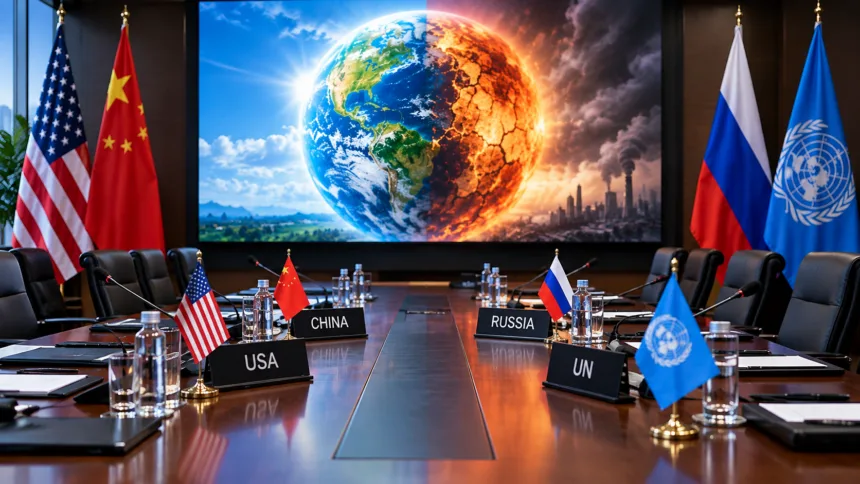
A geoengineering climate simulation held at Queen Mary University of London to model international climate diplomacy has collapsed without an agreement, according to a report by Wired. The exercise brought together specialists to explore whether global powers could successfully negotiate a planetary rescue plan.
Simulation Scope and Participants
Approximately 20 participants took part in the exercise, including scientists, military figures, former civil servants, and international relations experts. Delegates assumed the roles of representatives from the United States, Russia, China, and various international organizations.
The core objective of the experiment was to test whether an international agreement could govern solar geoengineering—a theoretical technology aimed at reflecting a portion of solar radiation to cool the planet.
Geopolitical Impasse and Industry Obstacles
During the negotiations, representatives of the United States and China refused to restrict their domestic research programs, citing strategic national interests. Driven by a mutual reluctance to surrender technological supremacy, the deliberations quickly deteriorated into accusations and friction.
Participants also failed to pay adequate attention to data regarding climate disasters. Warnings presented by an expert playing the role of a female climatologist were largely instrumentalized by parties to justify their own pre-determined positions. Furthermore, the scenario included deliberate disruption from a non-governmental organization backed by the fossil fuel industry, further stalling progress.
Consequently, no common ground was reached, and the mock international treaty remained unsigned.