
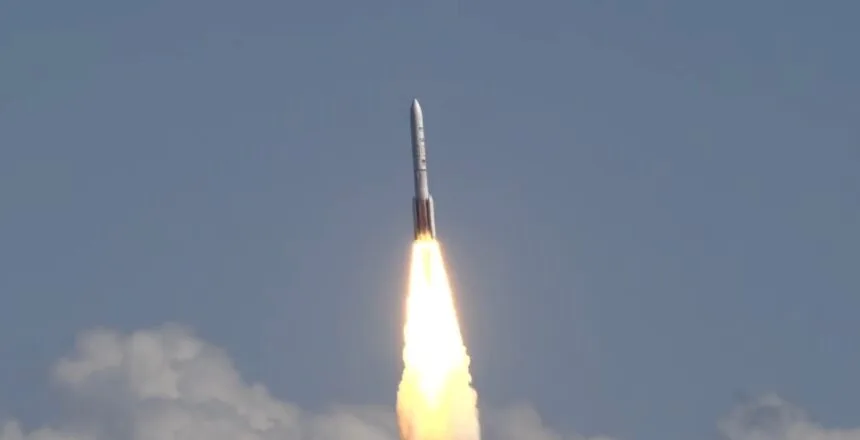
A United Launch Alliance Vulcan rocket suffered an in-flight anomaly roughly 10 minutes after liftoff on Sunday and failed to deliver 40 Amazon Leo broadband satellites to orbit. The launch took place from Space Launch Complex 41 at Cape Canaveral Space Force Station.
The mishap is the first complete flight failure for United Launch Alliance since the joint venture between Boeing and Lockheed Martin began operations in 2006. Built at the company's manufacturing facility in Decatur, Alabama, the 214-foot-tall rocket lifted off at 12:40 p.m. ET, generating 3.8 million pounds of thrust using two methane-powered BE-4 engines and six solid rocket boosters.
Upper Stage Malfunction Follows Countdown Holds
The launch followed two days of delays caused by a gaseous nitrogen supply outage on Friday and ground-network connectivity issues on Saturday. Launch controllers also paused the countdown at T-minus 20 seconds on Sunday for an undisclosed technical issue before resuming the flight.
While the solid rocket boosters jettisoned about one minute and 40 seconds into the flight, the BE-4-powered booster stage appeared to burn longer than planned and separated late. United Launch Alliance stated that an anomaly then struck during the Centaur upper stage's planned 12-minute and 15-second burn, preventing the payload from reaching orbit.
Commercial Deployment and Federal Flight Impact
The lost mission was the first of 38 contracted Vulcan launches purchased by Amazon to build out an internet network of more than 3,300 satellites. Amazon has deployed 396 Leo satellites across eight prior flights on Atlas 5 rockets, and Sunday's delivery would have increased the total count to 436. Amazon has booked additional constellation launches across other providers, including 24 flights on Blue Origin's New Glenn, 24 on Ariane 6, and 13 on SpaceX's Falcon 9.
"There is risk with any launch, and that's especially true for inaugural missions like LV-01," Amazon Leo said in a statement. The failure leaves future Vulcan scheduling subject to review, as the U.S. Space Force had previously paused Vulcan national security launches following booster nozzle irregularities on two earlier flights. NASA Administrator Jared Isaacman offered agency assistance for the investigation and remediation effort.