


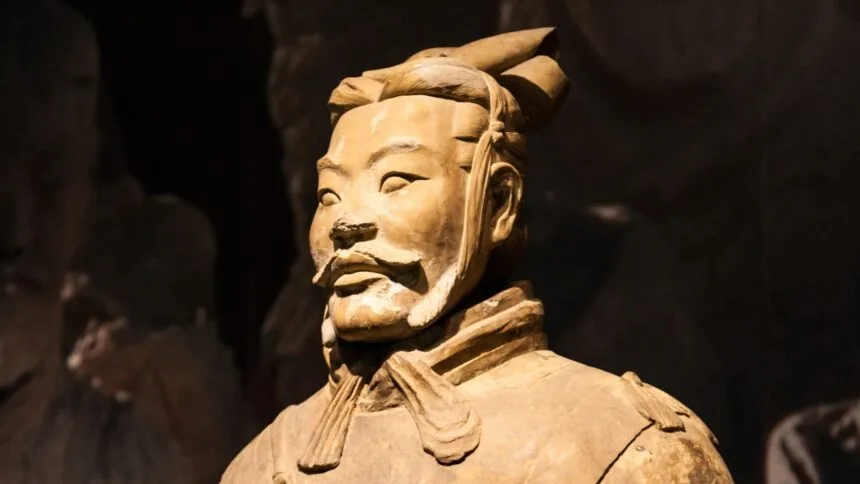
An analysis of 2,200-year-old Terracotta Army fingerprints on 36 clay statues in China has revealed that women and children helped build the imperial mausoleum alongside men. The study, led by archaeologist Xiaoxi Li and published in the Journal of Cultural Heritage, overturns long-held assumptions that Emperor Qin Shihuang's massive guardian army was produced exclusively by adult male laborers.
Who crafted the Terracotta Army?
A statistical model of 79 clay impressions revealed that adult men accounted for roughly 45 percent of the analyzed fingerprints, while adult women made up 32.7 percent and children under 15 contributed 22.3 percent. These biological traces confirm that ancient craft workshops integrated both female workers and young apprentices into large-scale imperial construction rather than relying solely on adult men.
Researchers analyzed the Terracotta Army fingerprints by measuring ridge spacing across impressions left on heads, arms, and armor to identify artisan age and sex distributions.
How ancient fingerprints preserve labor history
Artisans left 73 surface impressions while pressing, molding, and smoothing wet clay components, alongside six relief impressions created during the assembly of decorative armor pieces. By measuring the mean ridge breadth across the hardened clay marks, researchers were able to infer skeletal maturity and determine the demographic composition of Qin dynasty workshop labor.
Historical records from the era describe structured apprenticeship systems where young novices learned trade skills under senior supervisors. Ancient legal bamboo manuscripts note that apprentices received structured training over one to two years, aligning with physical evidence of youth participation on the statues.