

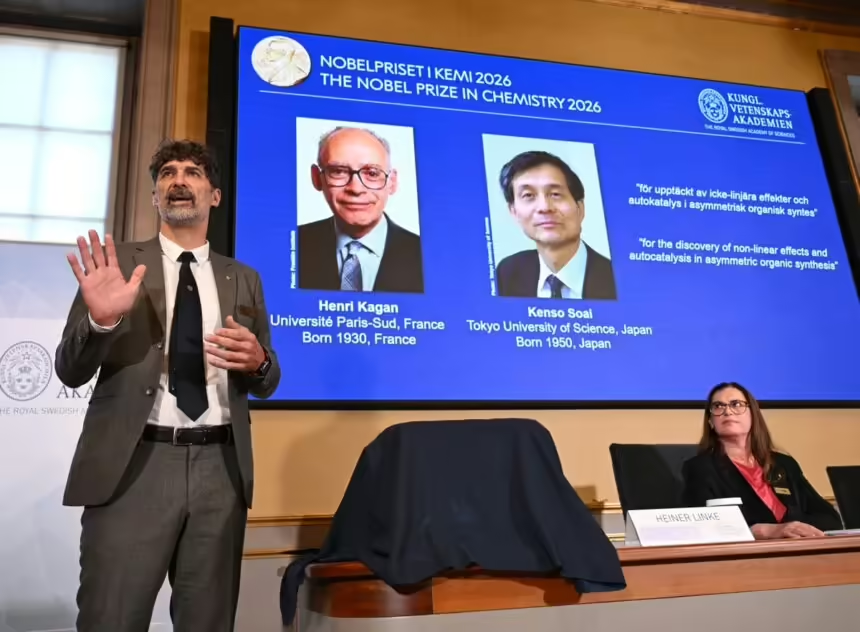
Henri Kagan and Kenso Soai have won the 2026 Nobel Prize in Chemistry for untangling molecular "handedness." The Nobel committee announced the award in Sweden on October 7, saying their work lets drugmakers build medicines from a single mirror-image molecule — which can mean safer, more targeted treatments.
What is molecular handedness?
Many molecules come in two mirror-image forms, like left and right hands. They look alike but behave differently: carvone smells of mint or caraway depending on which form is present. Living organisms normally build only one version — DNA sugars are right-handed, most protein amino acids left-handed — and chemists could not copy that preference in the lab.
For decades, lab experiments produced equal amounts of both forms. In 1986, Kagan, at the University of Paris-Sud, showed that an asymmetrical catalyst can steer a reaction toward one form. The effect is nonlinear: a small catalyst imbalance creates a much larger imbalance in the molecules produced.
Soai, of the Tokyo University of Science, designed reactions that make their own asymmetrical catalyst, amplifying the imbalance. In 2003 he published the reaction now called the Soai reaction, in which one mirror image made up the vast majority of the products.
Why does this work matter for medicine?
Older drugs were often racemates, 50-50 mixtures of both mirror forms. One form might treat the illness while the other is harmless or causes serious side effects. By showing how reactions can favour a single form, Kagan and Soai helped pharmacologists design more targeted medicines.
Rigoberto Hernandez, president of the American Chemical Society, said today's medicines would not be possible without this chemistry. Heiner Linke, who chairs the Nobel committee for chemistry, said the laureates' work produced a reaction that spontaneously creates only one mirror image. The Nobel Prize in Chemistry award comes with 12 million Swedish kronor, about $1.2 million, split between the two laureates.
The work does not explain how handedness first arose in nature. Soai, who was shopping when he learned of the award, called it one of the most exciting days of his life.