


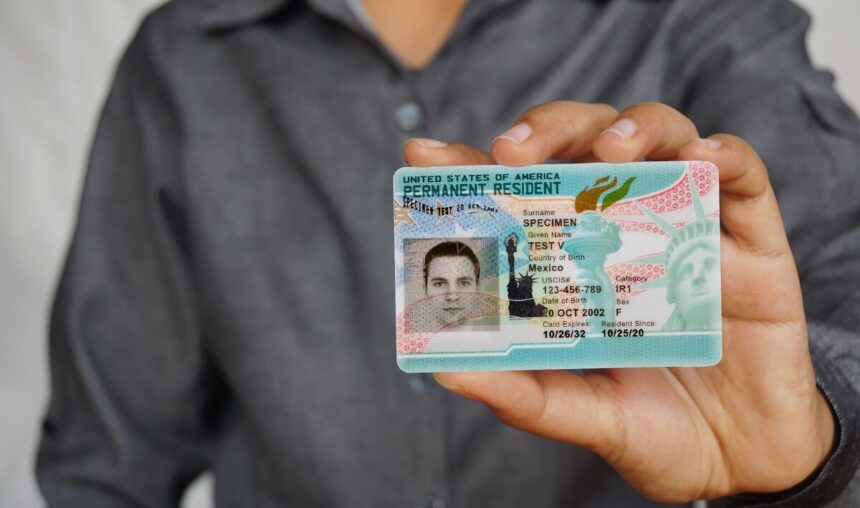
A comprehensive legislative proposal aimed at overhauling the United States legal immigration system has been introduced in Congress. Republican Senator Tommy Tuberville of Alabama introduced the “Americans First Immigration Act” in the Senate on September 23. The measure is currently not law and has been referred to the Senate Judiciary Committee for review. An identical bill was previously introduced in the House of Representatives on April 29 by Congressman Barry Moore. One of the bill’s most significant provisions is a proposal to eliminate the long-standing Diversity Visa lottery, commonly known as the Green Card lottery.
Eliminating the Diversity Visa for a Merit-Based Points System
The proposed legislation seeks to abolish the Diversity Visa lottery entirely, replacing it with an employment- and merit-based points system. Under this framework, foreign nationals seeking permanent residency through employment would be required to meet strict qualifying benchmarks. Applicants must be between 18 and 50 years of age (neither younger than 18 nor older than 51), attain a minimum threshold of 16 points, demonstrate verified English proficiency, and hold a bona fide job offer from a US employer.
The points-based formula evaluates candidates across several criteria, including offered wage level, educational attainment, English fluency, specialized professional and scientific achievements, military service, and age. Additional weight and higher scores would be allocated to applicants holding advanced degrees in STEM fields — science, technology, engineering, and mathematics — as well as designated medical disciplines.
Family Reunification Limits and Status of Pending Petitions
The bill also introduces major restrictions on family-based immigration channels. If enacted, family-based permanent residency pathways would be largely restricted to spouses and minor unmarried children. The legislation proposes eliminating new application avenues for the parents of US citizens and several other currently existing extended family preference categories.
Addressing claims circulating on social media that all ongoing immigration cases would face immediate cancellation, the bill outlines category-specific provisions. While unapproved petitions in certain family and employment categories would be discontinued upon enactment, specific transitional safeguards would remain in place for petitions approved prior to the law taking effect.
Employer Requirements and Constitutional Attestation
Stricter mandates are also outlined for employers petitioning for foreign talent. Companies would be required to document substantive efforts to recruit qualified workers within the domestic US labor market before hiring foreign personnel. Employers must also certify under designated conditions that domestic American workers are not being displaced or substituted by foreign hires.
Furthermore, candidates seeking permanent status under the points system would be mandated to attest to their allegiance to the principles of the US Constitution. Applicants must formally declare that they have never participated in genocide, religious persecution, honor killings, female genital mutilation, or other specified human rights abuses.
Current Legislative Status of the Bill
At this stage, the Americans First Immigration Act remains strictly a legislative proposal. To take legal effect, the bill must successfully navigate committee review, pass both chambers of Congress, and receive presidential approval. Consequently, the Green Card lottery has not been abolished, and existing rules remain fully operative. However, should the bill pass, it would represent one of the most substantial structural shifts in US legal immigration policy in recent decades.