
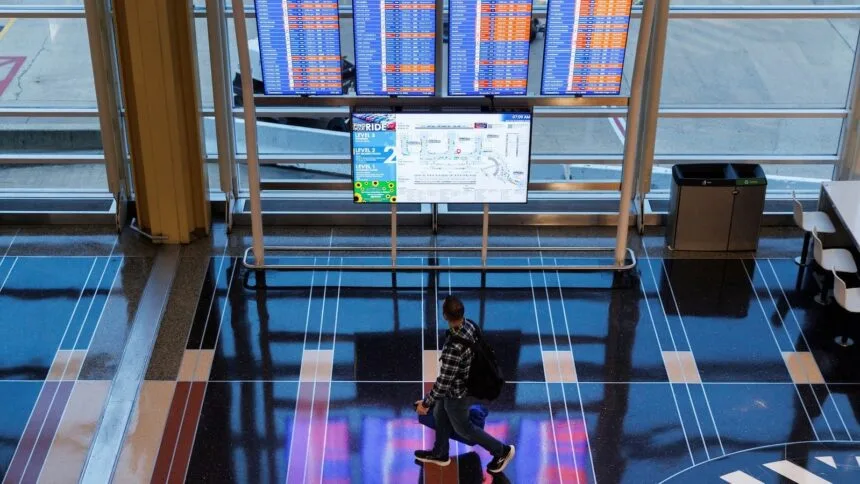
The Federal Aviation Administration suspended the installation of new Juniper routers while investigators examine a network failure that grounded nationwide departures on November 13, 2026. The stop lasted over four hours, marking the longest national flight grounding in 25 years.
The disruption began after a new Juniper router at an El Dorado, Arkansas, aviation facility sent a flood of data through the telecommunications network, overwhelming an older system. Transportation Secretary Sean Duffy stated that when the Arkansas device was activated, a system replaced about three weeks earlier in Amarillo, Texas, also began sending a flood of data through the network. During the incident, about 1,000 connection attempts reached the network in each four- to five-second interval, with instability spreading across 17 of the agency's 22 Air Route Traffic Control Centers.
Diagnostic Testing in Florida
Duffy said the issue arose on the 69th installation. The senators said L3Harris told their offices that the copper-to-fiber transition involved converting 3,648 routers to Juniper devices overseen by contractor L3Harris Technologies. Contractors have completed more than 70 percent of the broader copper-to-fiber modernization for the National Airspace System, according to L3Harris.
The Arkansas and Texas equipment was sent to an L3Harris facility in Florida, where government and vendor engineers are participating in diagnostic evaluation. Federal Aviation Administration Administrator Bryan Bedford noted that investigators recreated the conditions behind the fault but have not determined what triggered the router configuration change. Meanwhile, Hewlett Packard Enterprise claimed its Juniper equipment functioned according to how it was configured and did not suffer a hardware failure.
Safety Oversight and Modernization
In their letter, the senators called for further router installations to remain on hold until the equipment clears enhanced operational testing, independent validation, and rollback checks. Federal officials confirmed there is no evidence of sabotage or a cyberattack, and rejected speculation that artificial intelligence tools contributed, noting predictive analytics systems are separate from the router network. Following the incident, Duffy called on Congress to allocate $50 billion to modernize air traffic control systems.