
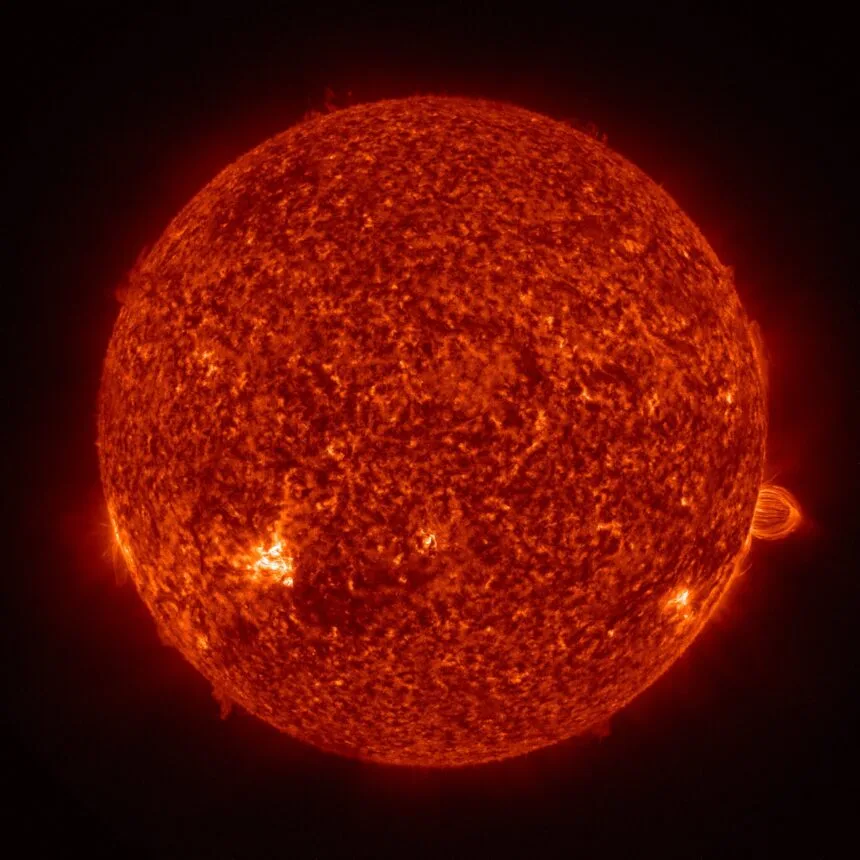
Physicists at the Shenguang-II laser facility in Shanghai have simulated solar coronal heating in laboratory plasma, offering fresh insights into why the Sun's atmosphere is dramatically hotter than its surface. The team, including researchers from the China Institute of Atomic Energy and Beijing Normal University, used high-powered lasers to trigger magnetic reconnection, demonstrating how falling plasma could drive nanoflares.
How did the experiment simulate solar coronal heating?
Researchers fired four laser beams at a rippled plastic target to generate expanding plasma that produced the Rayleigh–Taylor instability. This effect formed finger-like plasma structures with opposing magnetic fields. When the opposing fields collided and reconnected, stored magnetic energy converted into heat, pushing peak electron temperatures to roughly 820,000 °C, nearly double the temperature produced in a flat-surface control test.
The laboratory setup modeled conditions similar to coronal rain, where cooler, dense plasma sinks through the Sun's atmosphere along magnetic field lines. Researchers noted that computer simulations confirmed extra heating vanished when magnetic fields were prevented from forming, underscoring the role of magnetic reconnection in energy release.
What are the study's key findings and limits?
The study published in Physical Review Letters demonstrated that magnetic reconnection triggered by hydrodynamic instabilities can generate substantial thermal spikes. However, researchers acknowledged significant experimental limitations. The laboratory plasma was much denser than the corona and operated across far shorter timescales. Additionally, the experimental setup could not recreate the complete magnetic energy buildup observed in genuine solar nanoflares.