


What is the Black Eye Galaxy?
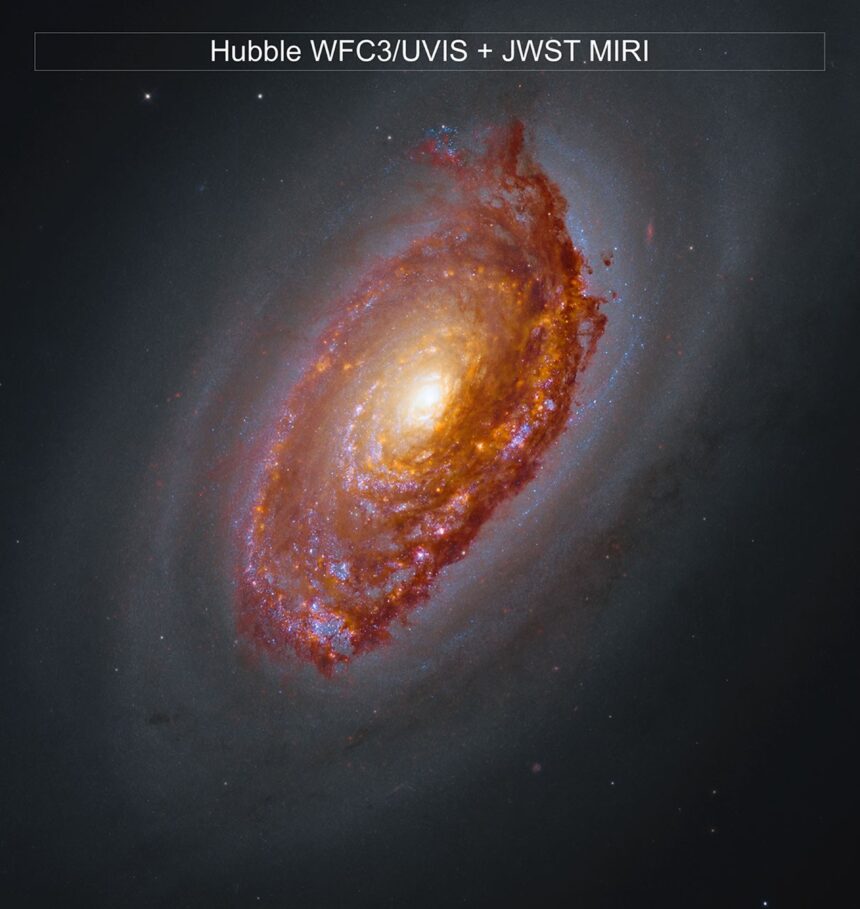
The James Webb Space Telescope has captured new infrared imagery of M64, a spiral galaxy famously known as the Black Eye Galaxy. The name comes from a prominent dark band of dust that partially obscures its bright core. By using the Mid-InfraRed Instrument (MIRI), researchers can now observe this dust in greater detail as it absorbs and re-emits light from newborn stars.
The galaxy is characterized by inner and outer gas regions that rotate in opposite directions. This counter-rotation is believed to be the result of a past merger with a smaller galaxy. Where these two opposing gas currents meet, they compress, creating active regions of increased star formation.
Why does the M64 merger matter?
M64 serves as vital evidence that spiral galaxies, including our own Milky Way, can experience significant mergers throughout their history. While these galaxies were once thought to have peaceful evolutionary paths, the structure and motion of the dust in M64 provide astronomers with new context regarding how such collisions influence the composition and long-term development of spiral galaxies across the universe.