


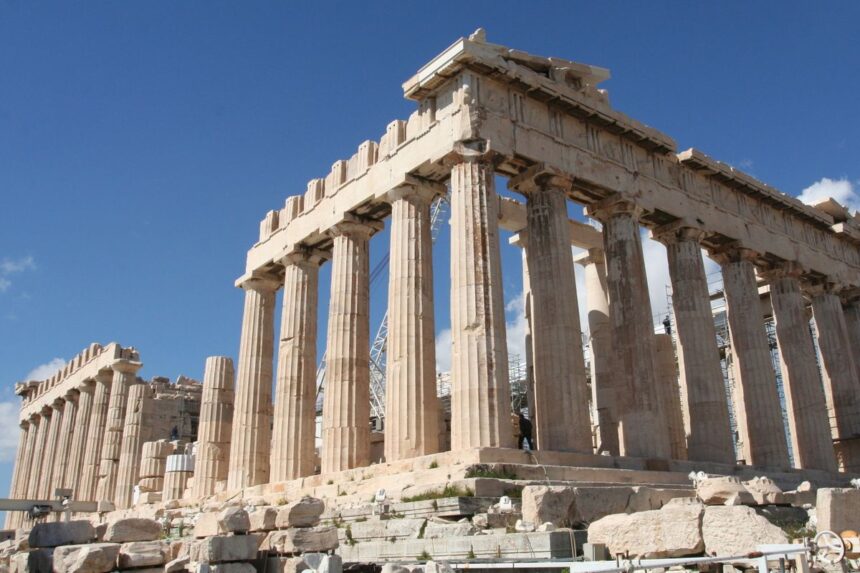
A new study published in Royal Society Open Science challenges the long-standing theory that the Parthenon’s architectural refinements were intended to correct optical illusions. Mathematician Alain Goriely of the University of Oxford argues there is no empirical evidence that these features, such as the temple's curved stylobate or bulging columns, produce the visual effects historically attributed to them, suggesting instead that the Parthenon optical illusion theory may be a myth.
Why were the Parthenon's curves designed?
The Parthenon's base, or stylobate, features a deliberate upward curve, with the center measuring over two inches higher than the sides. While long attributed to the Roman architect Vitruvius as a way to prevent a sagging appearance, researchers now suggest this curvature likely served practical purposes, such as effective water drainage, similar to the design of modern roads.
Goriely’s analysis indicates that while these physical attributes exist, they do not function as calculated attempts to trick the human eye. The research suggests that the Parthenon optical illusion theory lacks the necessary empirical support to explain these ancient architectural choices.
Are the Parthenon's columns an optical trick?
The study also disputes the theory that the temple's bulging columns, known as entasis, were designed to correct for perceived narrowing. Although these columns swell about an inch at their middle, the research finds no scientific evidence that straight-sided shafts would appear concave. Instead, the swelling likely conveys structural tension or provides stability for the temple's massive weight.
By applying modern mathematical analysis to these ancient structures, the research concludes that the Parthenon’s design is more a testament to functional engineering and aesthetic standards than a pursuit of illusory perfection.