


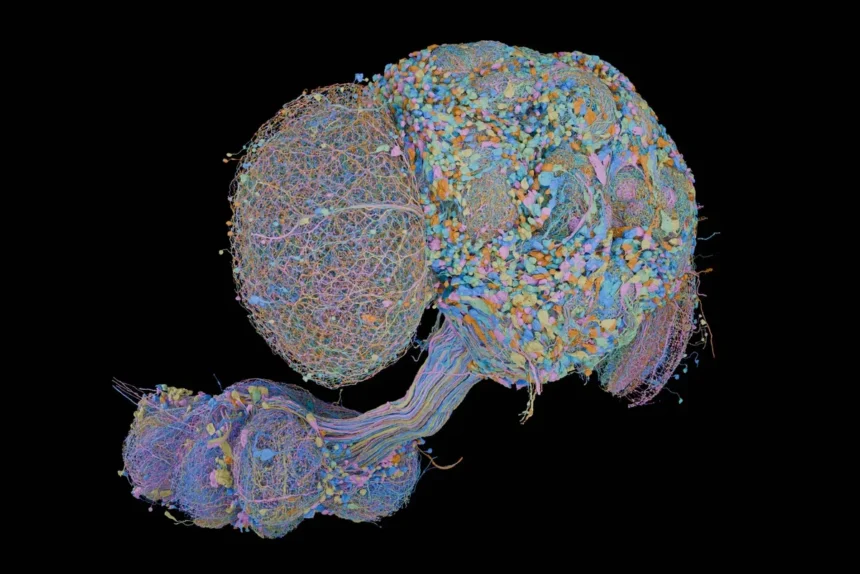
Researchers have successfully mapped the central nervous system of an adult male fruit fly, identifying 166,700 nerve cells and over 300 million synaptic connections. This new fruit fly brain map, published in September 2026, utilized electron microscopy and artificial intelligence to create a 3D wiring diagram. This breakthrough allows scientists to trace neural pathways from sensory inputs to behavioral outputs, providing a foundation for understanding how brain circuits function across different species.
What does the new fruit fly brain map reveal?
Researchers have successfully mapped the central nervous system of an adult male fruit fly, identifying 166,700 nerve cells and over 300 million synaptic connections. Published in September 2026, the study utilized electron microscopy and artificial intelligence to create a 3D wiring diagram. This breakthrough allows scientists to trace neural pathways from sensory inputs to behavioral outputs, providing a foundation for understanding how brain circuits function across different species.
Why is mapping fruit fly neurons important?
By comparing this male map to previous female fruit fly data, scientists discovered that while only 5 percent of cell types differ between sexes, these variations drive distinct social behaviors. Understanding these neural networks helps researchers explore how genes influence brain circuits and how sensory information, such as taste and vision, is processed. Experts suggest that decoding these fundamental mechanisms in insects offers vital insights into the complex architecture of all brains, including humans.