


Why do personal finances and consumer sentiment differ?
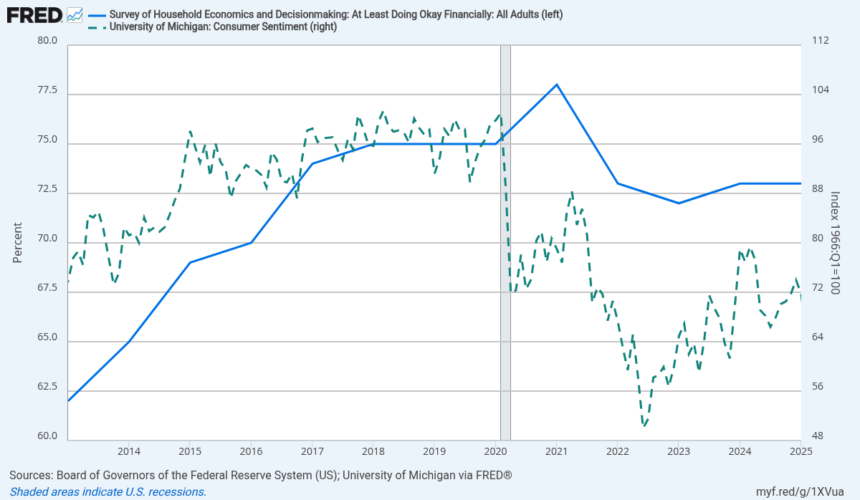
While most Americans report feeling financially stable, overall consumer sentiment remains significantly lower than pre-pandemic levels. Data shows that while 73% of adults felt they were doing at least okay financially in 2025, the University of Michigan’s Index of Consumer Sentiment dropped from 95.9 in 2019 to 71.7 in early 2025, revealing a clear gap between personal security and broader economic outlooks.
This divergence suggests that individuals can feel relatively secure about their own financial position while remaining pessimistic about the national economy. Consumer sentiment metrics are broader, incorporating business and buying conditions, whereas personal financial surveys focus strictly on individual circumstances. This allows for a scenario where households report stability while still harboring concerns about the general state of the economy.
Is there a link between sentiment and financial change?
When households are asked if they are worse off than they were 12 months ago, the data aligns more closely with the decline in consumer sentiment. This suggests that while current financial status remains steady for many, the perception of change over the past year is a stronger indicator of how people view the overall economy compared to their static financial standing.
The Federal Reserve’s Survey of Household Economics and Decisionmaking provides these insights by tracking both current well-being and year-over-year changes. The findings indicate that while many people feel they are currently doing okay, the trend of feeling worse off compared to the previous year mirrors the downward shift in national sentiment indices, highlighting how the pace of economic change influences public perception.