


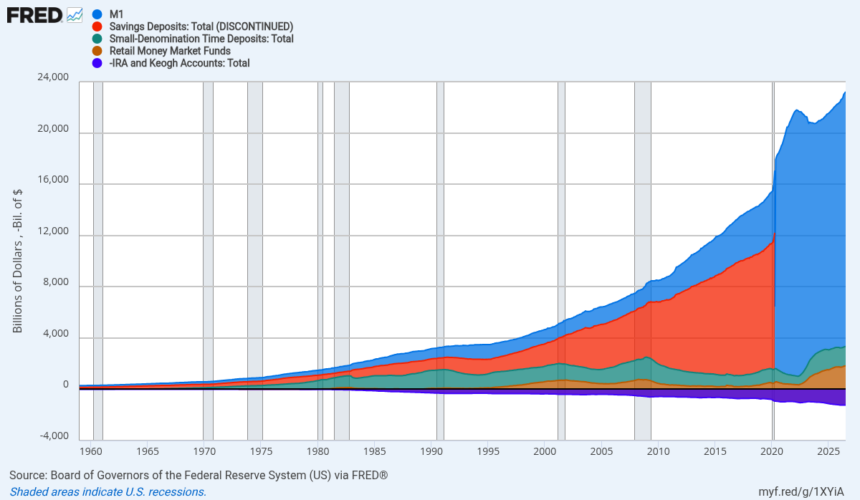
What is the M2 money supply?
The M2 money supply is a key economic indicator measuring the total amount of money readily available in the United States. As of June 2026, this figure reached $23 trillion. It includes highly liquid assets like checking accounts and cash, while excluding non-liquid assets such as individual retirement accounts (IRAs) and Keogh plans, which are not easily converted to cash.
The Federal Reserve tracks these figures through its weekly H.6 statistical release. Because retirement accounts carry penalties for early withdrawal, their total value is subtracted from the broader calculation to ensure the data accurately reflects money accessible for immediate spending.
Why did the Federal Reserve change M2 reporting?
Starting July 28, 2026, the Federal Reserve updated how it subtracts IRA and Keogh balances from the M2 money supply. These balances are now subtracted from the total value rather than from individual sub-components. This change reflects that a growing share of retirement funds is held in standard savings and checking accounts rather than traditional time deposits.
While this methodological shift required the recalculation of certain sub-components, officials confirmed the update had almost no impact on the overall total value of M2. This adjustment ensures that economic data remains consistent with current banking trends where retirement assets are increasingly integrated into standard depository accounts.